TrajeQ: Trajectory-Preserving Flow Matching Quantization for Low-bit Video Generation

1Anonymus

TL;DR

TrajeQ preserves flow-matching video generation under extreme low-bit quantization by reducing velocity-orientation drift via direction-aware bit allocation and sensitivity-guided layer preservation, achieving SOTA VBench performance.

Abstract

While flow matching (FM) has emerged as a prominent paradigm for high-quality video generation, its significant computational overhead presents a major obstacle to practical implementation. Although post-training quantization (PTQ) is an established approach for efficient generation, existing PTQ methods primarily minimize reconstruction error in a magnitude-centric manner. This objective is misaligned with deterministic FM trajectories, where low-bit quantization introduces velocity-field orientation errors that can compound across integration steps and drive the generation trajectory off-manifold. To address this issue, we introduce TrajeQ to preserve the geometric integrity of the velocity field and reduce trajectory drift under low-bit quantization. Our approach introduces Curvature-Adaptive Quantization (CAQ) to detect angular shifts across timesteps and mitigate geometric distortion via adaptive precision. We also integrate Directional Bottleneck Preservation (DBP), a sensitivity-guided precision assignment scheme that retains only the most vulnerable layers in full precision. Experiments demonstrate that TrajeQ achieves state-of-the-art VBench performance and maintains stable video generation under extreme W4A4 and W3A6 quantization regimes where existing methods collapse. We provide the code in the supplementary material and the video results on the https://anonymous-orange.github.io.

Figure 1: TrajeQ Overview

Generation Quality on VBench

FP16

TrajeQ W6A6

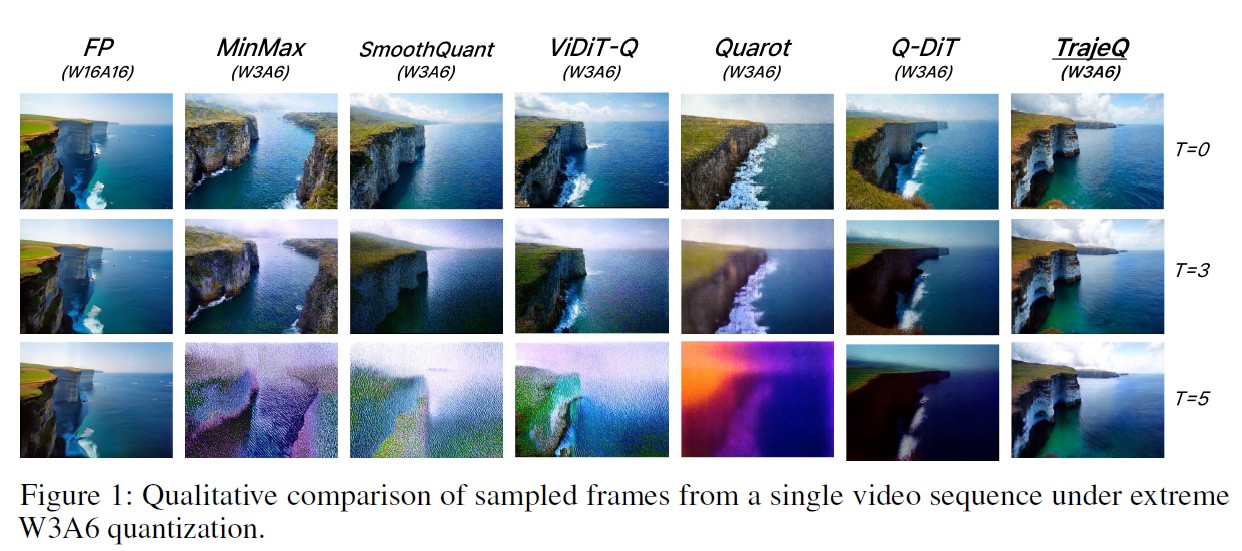
Extreme Compression Performance (W6A6 vs W3A6)

FP16

TrajeQ W6A6

TrajeQ W3A6

Method

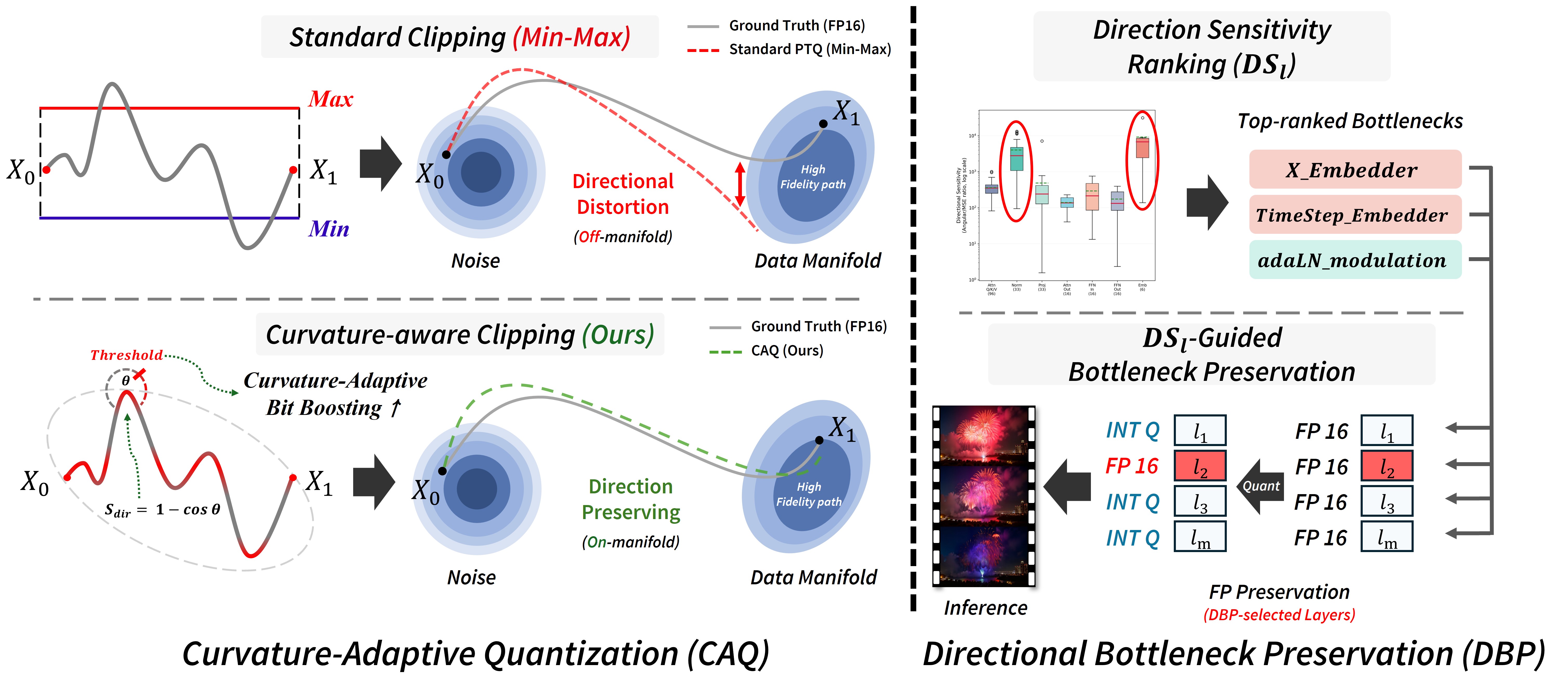
TrajeQ is the first quantization framework specifically engineered to preserve the geometric trajectory of Flow Matching models. In contrast to conventional approaches that minimize magnitude error and often lead to significant trajectory drift, TrajeQ prioritizes the integrity of vector field directionality. Our framework integrates two complementary mechanisms: Curvature-Adaptive Quantization (CAQ), which dynamically adapts precision by detecting trajectory curvature in real-time, and Directional Bottleneck Preservation (DBP), which identifies and safeguards structural bottlenecks. This synergistic approach enables TrajeQ to achieve high-fidelity video generation without structural collapse.

Figure 1: TrajeQ Overview

Curvature-Adaptive Quantization (CAQ)

Motivation

Flow Matching trajectories are geometrically non-uniform, containing high-curvature regions that are intrinsically unstable. Standard methods fail to account for this geometric nuance, causing significant drift when these critical "inflection points" are under-resolved by static quantization.

Key Mechanism
  • Curvature Sensitivity Identification: CAQ utilizes a cosine-based curvature proxy to precisely locate geometric segments where the trajectory changes direction rapidly, identifying them as high-sensitivity intervals prone to error amplification.
  • Adaptive Precision: When it detects sharp geometric turns (high curvature), it dynamically allocates higher precision to that specific step, compensating for the increased sensitivity.
Impact

By prioritizing directional integrity over simple magnitude preservation, CAQ effectively minimizes angular distortion. This ensures the generated video follows the correct deterministic path without diverging into noise or artifacts.
Directional Bottleneck Preservation (DBP)

Motivation

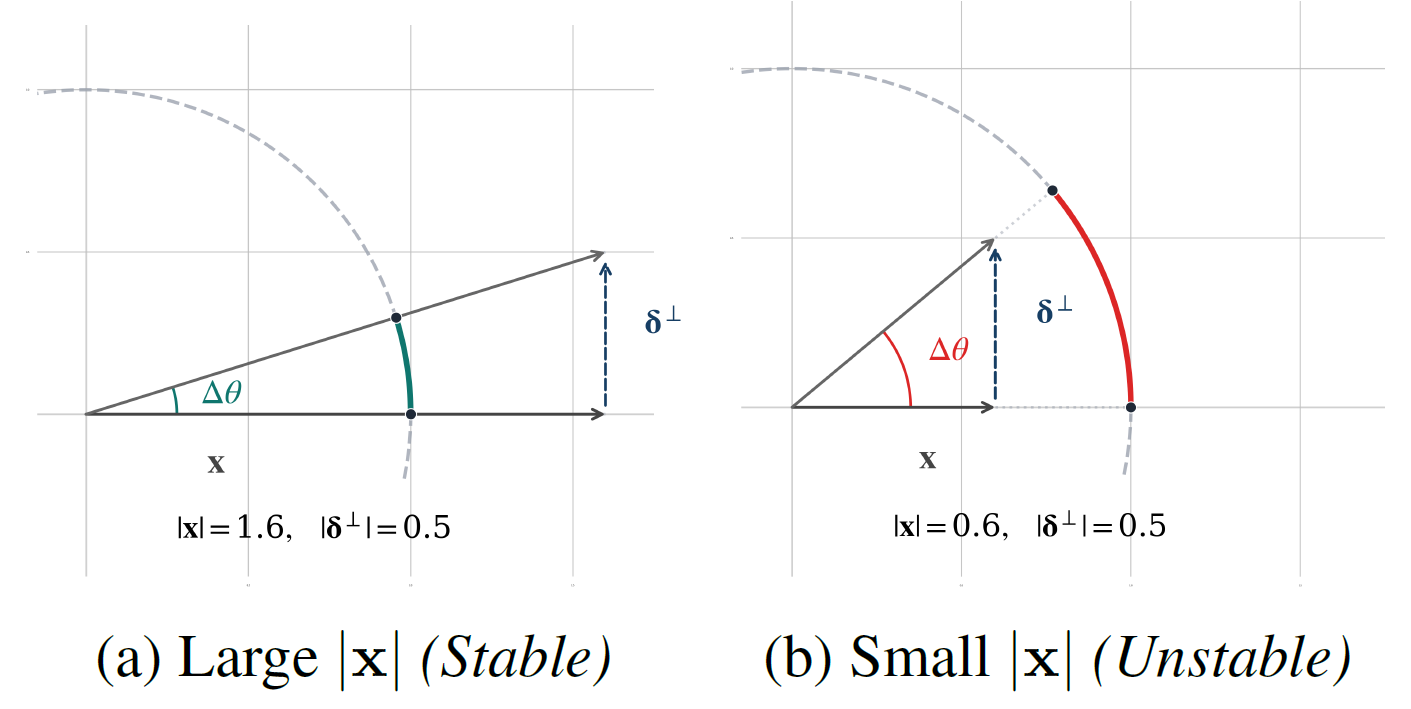
Standard error metrics like MSE often overlook layers with small activation magnitudes. However, our theoretical analysis reveals that these "structural bottlenecks" are geometrically unstable; even minimal quantization noise in these layers triggers disproportionately large angular deviations.

Key Mechanism
  • Layer Sensitivity Analysis: We introduce a novel metric called "Directional Sensitivity (DS)" to pinpoint vulnerable layers prone to angular distortion.
  • Strategic Preservation: Guided by upon metric, DBP selectively retains the identified structural bottlenecks in FP16 precision. This targeted protection neutralizes error amplification in critical components, allowing the majority of the model to be efficiently quantized without structural collapse.
Impact

This strategy prevents catastrophic quality degradation, such as color collapse or texture washout. It enables the model to maintain high-fidelity structural consistency and vivid details even under extreme low-bit quantization regimes.

CAQ Visualization
DBP Visualization

Experimental Results

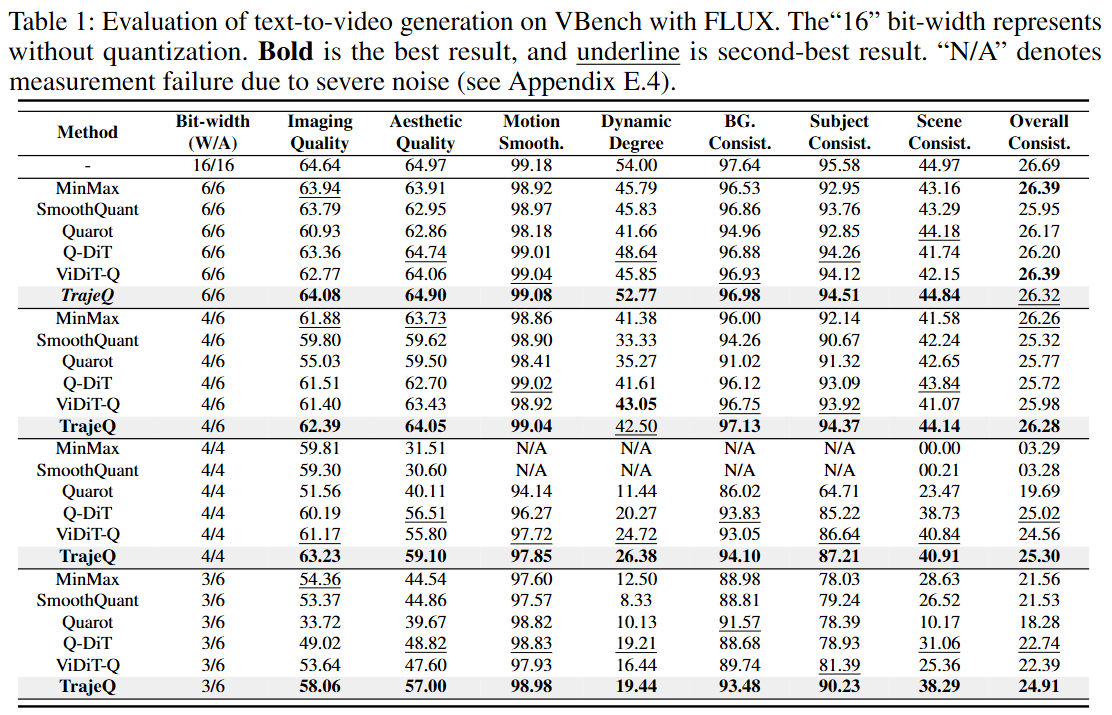
Table 1: VBench Performance Comparison

Table 1: VBench Performance Comparison

Quantitative evaluation on VBench demonstrates TrajeQ's superior performance across various quantization schemes. At W6A6, TrajeQ achieves near-lossless quality comparable to FP16, while maintaining robust structural integrity even under the extreme W3A6 regime.

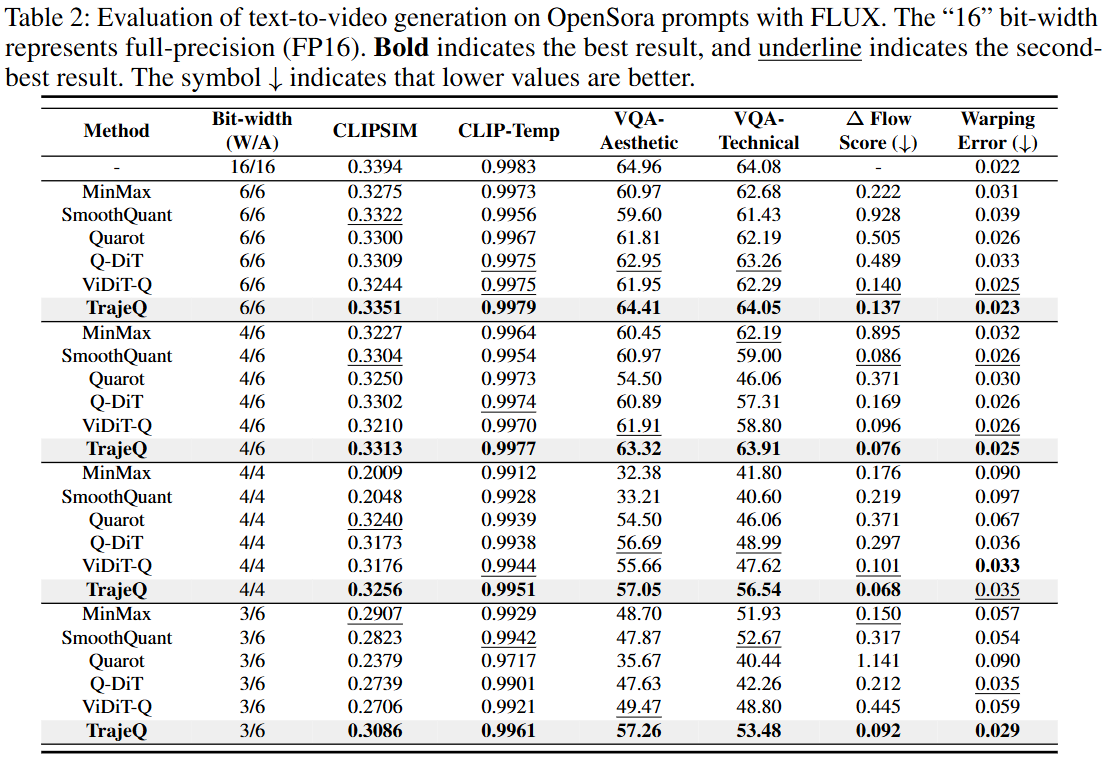
Table 2: OpenSora Performance Analysis

Table 2: OpenSora Performance Analysis

Performance comparison on OpenSora prompts. TrajeQ achieves SOTA results across all bit-widths, delivering superior visual fidelity and motion stability compared to existing quantization methods.

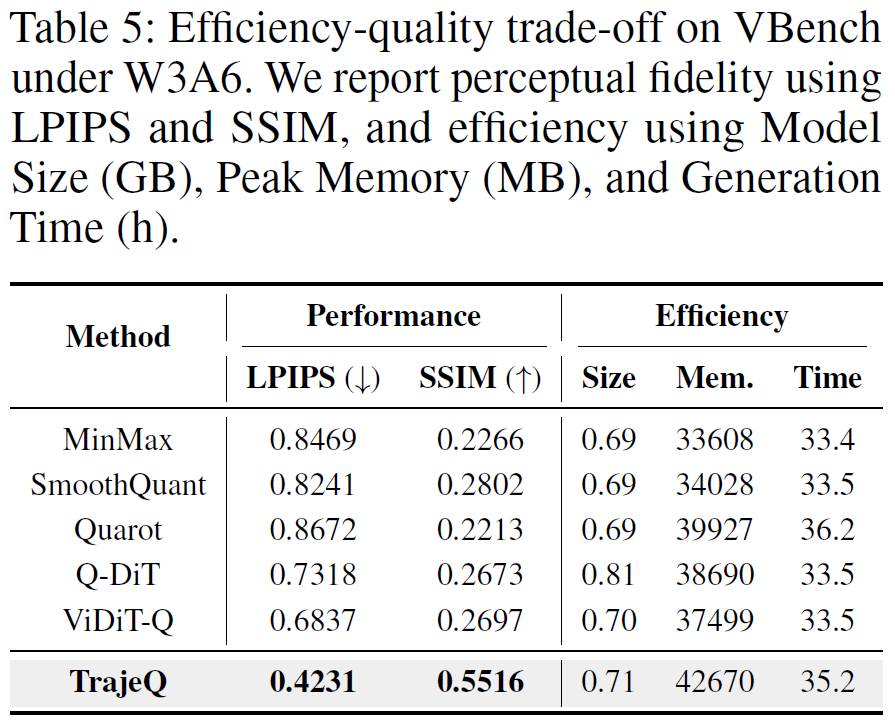
Table 3: Computational Cost Analysis

Table 3: Method Ablation Study

Efficiency-quality trade-off analysis on VBench. Under the challenging W3A6 regime, TrajeQ consistently surpasses existing baselines across both perceptual (LPIPS) and structural (SSIM) metrics, establishing a more favorable balance between aggressive compression and generation fidelity.

Quantization Quality Comparison (VBench)

MinMax W6A6
Volumetric Artifacts

ViDiT-Q W6A6
Physics Inconsistency

TrajeQ W6A6

MinMax W6A6
Object Missing

ViDiT-Q W6A6
Structural Distortion

TrajeQ W6A6

MinMax W6A6
Temporal Warping

ViDiT-Q W6A6
Scale Inconsistency

TrajeQ W6A6

MinMax W4A6
Perspective Distortion

ViDiT-Q W4A6
Structural Deformation

TrajeQ W4A6

MinMax W4A6
contrast collapse

ViDiT-Q W4A6
chromatic deviation

TrajeQ W4A6

Extreme Quantization: W4A4 Comparison

TrajeQ maintains visual coherence and structural integrity even at the extreme W4A4 quantization regime, where standard methods completely fail to preserve meaningful content.

"Iron Man flying in the sky"

"River"

MinMax

"Iron Man flying in the sky"

"River"

SmoothQuant

"Iron Man flying in the sky"

"River"

QuaRot

"Iron Man flying in the sky"

"River"

Q-DiT

"Iron Man flying in the sky"

"River"

ViDiT-Q

"Iron Man flying in the sky"

"River"

TrajeQ (Ours)

Future Work

While TrajeQ analyzes the geometric trajectory of velocity vectors, future work will investigate how quantization alters internal feature representations, especially whether it disrupts the geometry of superposed features.